
A common misconception is that a multi-chain wallet is simply a single wallet with more networks listed in a menu. In practice, adding chains changes the user’s risk surface, transaction workflow, and mental model. A token may share a familiar name across networks while representing different contracts. A transaction that looks routine on one chain may interact with a completely different application on another. For US-based DeFi users, the practical question is therefore not only whether a wallet supports many networks, but whether it helps the user understand what is about to happen before signing.
Consider a familiar scenario. An investor moves assets between an Ethereum-based application, a layer-2 network, and a decentralized exchange on another EVM-compatible chain. The wallet address may remain the same because these networks use compatible account formats, yet balances, permissions, gas requirements, bridge assumptions, and application contracts all vary. The convenience of one address can hide the fact that the user is moving through several separate execution environments. This is where a browser extension such as Rabby Wallet becomes more interesting: its value is not merely storage, but transaction interpretation and workflow organization.
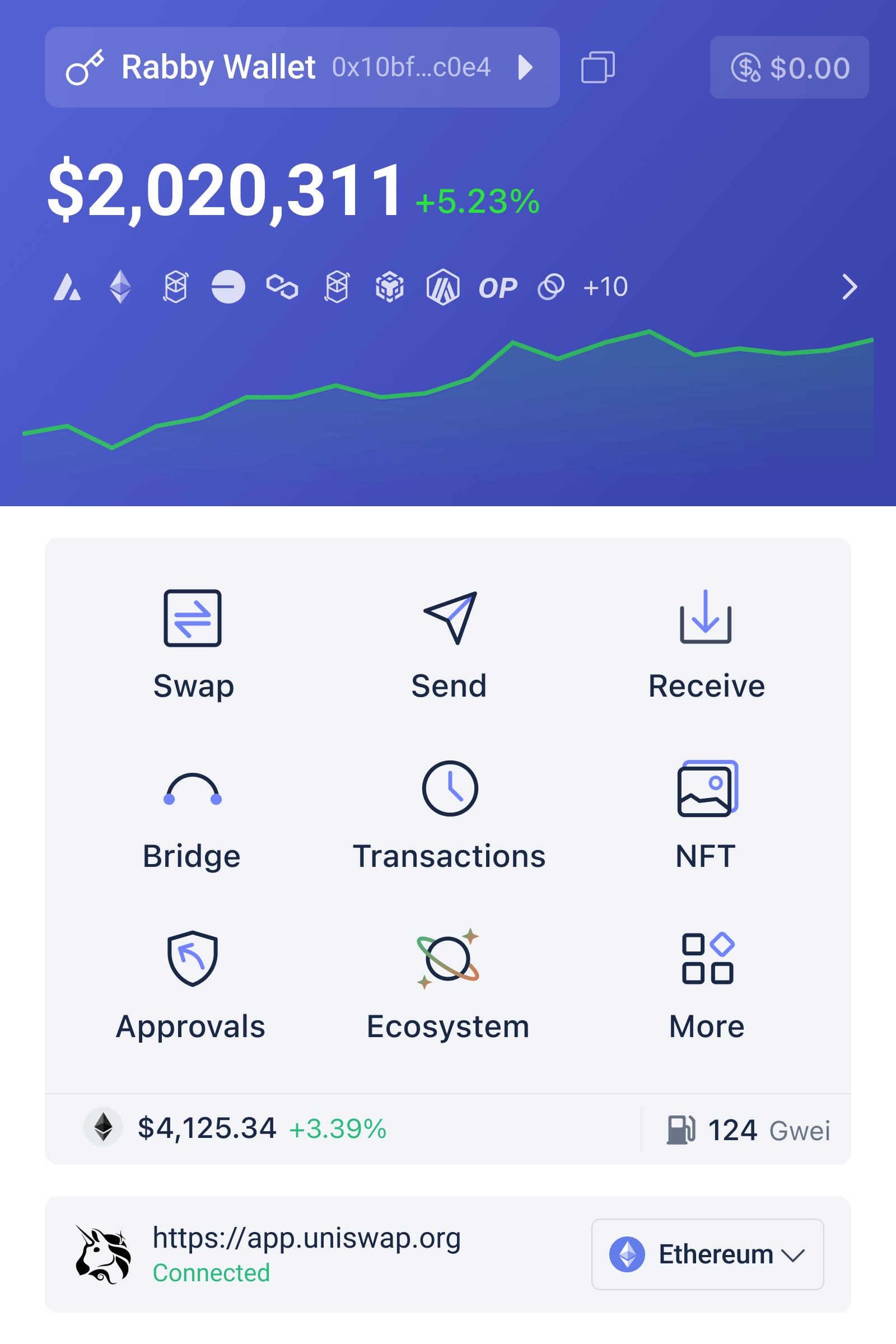
The key mechanism: one account, many execution environments
Rabby Wallet is commonly used as a browser-based cryptocurrency wallet for decentralized applications, particularly across Ethereum and compatible networks. The term “multi-chain” can be misleading, however. It does not mean that all chains have merged into one shared ledger. Each network still maintains its own state. Your balance on one chain is not automatically available on another, and a token held on one network may not be the same asset as a token with the same ticker elsewhere.
What the wallet does is provide a unified interface for interacting with several networks. It can expose account balances, connect to decentralized applications, and request signatures or transactions from the same browser workflow. The underlying operations still depend on the selected chain, the application’s smart contracts, and the network’s fee system. A wallet can simplify the interface without eliminating the technical distinctions underneath.
This distinction matters because users often treat the wallet address as the asset itself. The address is better understood as an identity used by an account on compatible networks. The assets and permissions associated with that identity are recorded separately by each chain. If a user approves a decentralized exchange to spend a token, that approval is generally associated with a specific token contract on a specific network. Moving to another chain does not automatically reproduce the same approval, nor does it necessarily eliminate risk from the first one.
What Rabby’s transaction-first approach can clarify
The most useful wallet feature for an active DeFi user is not a colorful portfolio view. It is a more legible signing decision. Before approving an operation, users need to know which network is involved, which contract will receive the call, what assets may leave the account, and whether the transaction creates a continuing permission such as a token allowance.
A transaction simulation or pre-signing interpretation can improve this decision by translating low-level contract activity into a more understandable outcome. That does not make the result infallible. Smart-contract behavior can depend on external data, execution order, market conditions, and code paths that are difficult to model perfectly. Still, there is an important difference between signing opaque encoded data and signing after reviewing an estimate of the resulting state change.
This is a subtle but important correction to the idea that wallets “protect” users. A wallet extension cannot make a malicious application legitimate, reverse a confirmed transaction, or guarantee that a simulation captures every possible outcome. Its stronger role is cognitive: it can reduce the distance between what a user thinks they are authorizing and what the network is likely to execute. That reduction is valuable precisely because DeFi transactions are often irreversible and composable.
Users considering the rabby extension download should treat installation as the beginning of a security process, not the end. The extension should be obtained from a trustworthy source, the wallet should be backed up through its proper recovery method, and the seed phrase or private key should never be entered into a website claiming to provide support. A well-designed interface cannot compensate for a compromised recovery phrase.
Why multi-chain convenience creates new failure modes
Multi-chain wallets reduce friction, but friction sometimes carries information. When a user must deliberately switch networks, acquire the correct gas asset, and confirm the destination chain, those interruptions can expose a mistake. A unified interface may make the workflow faster while also making different environments feel deceptively similar.
Bridging illustrates the boundary. A bridge is not simply a transport pipe for coins. Depending on its design, it may lock assets, mint representations, rely on validators, use messaging systems, or route through liquidity. The risk is therefore partly technical and partly operational. A wallet can help display the network and transaction context, but it cannot remove the bridge’s trust assumptions. If a transfer fails, arrives on an unexpected network, or produces a wrapped representation, the user may need to understand both the wallet and the bridge.
There is also a naming problem. Token symbols are not unique identifiers. Two assets can share a ticker while having unrelated contracts and different liquidity. A careful user should inspect the network, contract identity, and application context rather than relying on a familiar symbol. This is one reason wallet interfaces that surface chain-specific details are more useful than interfaces that show only a simplified balance.
Another limit concerns approvals. Many DeFi applications ask for permission to spend tokens on the user’s behalf. An approval may be broader or longer-lasting than the immediate trade appears to require. Revoking unnecessary allowances can reduce exposure, but revocation itself is an on-chain transaction and therefore costs fees. The sensible approach is not to reject every approval automatically; it is to understand the scope, review whether the application is trusted, and periodically clean up permissions that are no longer needed.
A practical framework for using a browser wallet
A reusable decision process is more valuable than memorizing a list of wallet features. Before connecting to an application, identify the network and confirm that the site address is correct. Before signing, ask what asset can move, which contract is being called, and whether the action creates an allowance or other persistent permission. After signing, verify the transaction status on the relevant network rather than assuming that a browser notification means final settlement.
It is also useful to separate three kinds of confidence. First is interface confidence: the wallet shows the action clearly. Second is protocol confidence: the application and contracts have credible security assumptions. Third is operational confidence: the user has the correct network, gas asset, account, and recovery setup. A strong wallet may improve the first category, but it does not automatically establish the other two.
For larger balances, many users may reasonably prefer a separation between everyday activity and long-term holdings. A browser extension is convenient for frequent DeFi interaction, while a more isolated signing arrangement can reduce the consequences of a compromised browser session. The trade-off is speed. More controls introduce additional steps, and those steps can frustrate users during time-sensitive transactions. Security is therefore not a single switch; it is an allocation of convenience, exposure, and verification effort.
What to watch as DeFi wallets evolve
The most meaningful development path for multi-chain wallets is likely to be better interpretation rather than merely longer network lists. As applications become more composable, a single transaction can trigger multiple contract calls, asset transfers, and permission changes. The useful question will be whether a wallet can explain these relationships without reducing them to an overconfident summary.
Users should watch for clearer distinctions between simulation and certainty, stronger handling of unfamiliar contracts, better visibility into approvals, and more transparent explanations of bridge and network risks. If these tools improve, the wallet may become less like a digital keychain and more like a transaction review layer. That would not eliminate smart-contract risk, but it could help users make fewer avoidable signing mistakes.
Frequently asked questions
Is Rabby Wallet only for one blockchain?
No. Rabby Wallet is designed for multi-chain use across Ethereum-compatible networks. Each network still has its own balances, contracts, fees, and security assumptions, so multi-chain support should not be confused with a single shared blockchain.
Does a wallet simulation guarantee that a transaction is safe?
No. A simulation can provide useful evidence about an expected outcome, but it is not a guarantee. Smart-contract state can change, external data can affect execution, and malicious applications may be designed to exploit assumptions. Users should combine transaction review with application, network, and permission checks.
What should I check before installing a browser wallet extension?
Use a trustworthy distribution source, verify that the extension is the intended product, protect the recovery phrase offline, and never share it with a website or support representative. After installation, test the workflow with a small amount before committing significant funds.
The central lesson is that a multi-chain wallet does not remove complexity; it organizes complexity into a more usable interface. That is a meaningful improvement when the interface exposes network context, permissions, and expected transaction effects. But the final responsibility remains with the signer. In DeFi, the safest habit is not blind trust in a wallet or an application. It is learning to ask, before every consequential signature, which chain is acting, which contract is involved, and what capability is being granted.